your creative autobiography

More from “The Creative Habit” by Twyla Tharp. A questionnaire to help you unearth Your Creative Autobiography. I’m putting this out there for you to work on personally, privately. Feel free to share your answers to any questions in the comments section, if you’d like — I’d be happy to read them and would certainly commend your bravery — but I think this is mostly personal private work that will take time and require soul-searching.

I realize this kind of stuff may not be everyone’s cup of tea, but I’m into it, so I’m putting it out there for you to have a look at. Even if you think it’s not your thing, give it a try. If the entire questionnaire seems too daunting, try answering a few questions for now. Who knows what might reveal itself? Mind-blowing epiphanies may await you!

All righty. The questions, 33 in all, on Your Creative Autobiography:

1. What is the first creative moment you remember?

2. Was anyone there to witness or appreciate it?

3. What is the best idea you’ve ever had?

4. What made it great in your mind?

5. What is the dumbest idea?

6. What made it stupid?

7. Can you connect the dots that led you to this idea? (She doesn’t specify if she’s talking about the great idea or the dumb one, so pick one — or do both.)

8. What is your creative ambition?

9. What are the obstacles to this ambition?

10. What are the vital stops to achieving this ambition?

11. How do you begin your day?

12. What are your habits? What patterns do you repeat?

13. Describe your first successful creative act.

14. Describe your second successful creative act.

15. Compare them.

16. What are your attitudes toward money, power, praise, rivals, work, play?

17. Which artists do you admire most?

18. Why are they your role models?

19. What do you and your role models have in common?

20. Does anyone in your life regularly inspire you?

21. Who is your muse?

22. Define muse.

23. When confronted with superior intelligence or talent, how do you respond?

24. When faced with stupidity, hostility, intransigence, laziness, or indifference in others, how do you respond?

25. When faced with impending success or the threat of failure, how do you respond?

26. When you work, do you love the process or the result?

27. At what moments do you feel your reach exceeds your grasp?

28. What is your ideal creative activity?

29. What is your greatest fear?

30. What is the likelihood of either of the answers to the previous two questions happening?

31. Which of your answers would you most like to change?

32. What is your idea of mastery?

33. What is your greatest dream?

san diego shark attack

This is horrible news. Happened this morning. Very near where my brother surfs regularly. This stuff terrifies me. I’m fighting the impulse to make a hysterical sister phone call to my brother which would mostly sound like this:

“EEEEEEEEeeeeeeeEEEEEEeeee!” That usually doesn’t work on him.

But I’ve been freaked out all day basically.

The latest update is that it WAS a Great White shark, approximately 12-17 feet in size. Ugh. I’m sick about this. So sorry about this man.

You know, there’s an issue here that may very well be a contributing factor. Something that I’ve heard local people talking about today. Nearby where this attack happened, in La Jolla actually, there’s a cement block wall that curves out into the ocean in a crescent shape. The wall has a walkway on top for sightseers, etc. But the original purpose of this wall was to create a children’s pool area. A shallow place for them to play, wade around. People who wanted to nurture this children’s pool area favored a net, a mesh divider, something, to protect the little beach from seals and predators. As I recall it anyway. This goes back a number of years here. Environmentalists howled about that. So as time went on, the area became overrun with seals — to the point where people are no longer allowed to go down to this beach, much less kids. It is now a seal beach. A loud smelly shark bait beach.

“the creative habit”

Right now, I’m reading “The Creative Habit” by dancer/choreographer Twyla Tharp. Tearing through it, actually, would be more accurate. Gobbling it like a pig. So much so that I’ve forced myself to slow down, start over. I’ve become a little obsessed lately with this kind of thing. The creative process. Mine. Others’. Anyone’s. The whole gamut. Picking up this book was totally knee-jerk on my part. I have huge respect for Twyla Tharp’s work, but I think it was the title that did it and, again, because I’m gobbling up anything about this topic right now. Suu-EEE!!

So I’ve started the book over, as I said, and there’s so much I’d like to share from it. If you’re interested in the creative process, where it comes from, how to access it, call it forth, whatever, I think you’ll like what I post from the book. Some of it will be straight excerpts. Some of it will be exercises or quizzes. Which sounds lame, I know, but they’re fascinating to me. Beyond that, I just really like the way she writes, the way she analyzes the process, how she cuts through to the heart of things. She’s a smart dame, she is. She approaches the creative process with an almost clinical eye and I’m just really INTO her whole groove right now.

So the context for this first excerpt: In this particular chapter, she’s been talking about people’s creative DNA as she calls it. How each person is hard-wired for their art, their creative process, differently. She talks, for instance, about how some artists see the world through a wide lens — say, someone like Ansel Adams who uses this grand, sweeping scope. Others use a kind of mid-lens, a middle distance. She uses the example of choreographer Jerome Robbins and talks about how his point of view was right there on the stage, observational. In West Side Story, for example. Sharks watch Jets. Jets watch Sharks. Boys watch girls. Girls watch boys. That’s how the dances are choreographed, with that observational middle distance. Other artists see the world in close-up. The tight shot. Someone like Raymond Chandler with his razor-sharp detail that basically crams us into his character’s skulls, as in the opening from The Big Sleep:

It was about eleven o’clock in the morning, mid October, with the sun not shining and a look of hard wet rain in the clearness of the foothills. I was wearing my powder-blue suit, with dark blue shirt, tie and display handkerchief, black brogues, black wool socks with dark blue clocks on them. I was neat, clean, shaved, and sober, and I didn’t care who knew it. It was everything the well-dressed detective ought to be. I was calling on four million bucks.

So the whole wide lens/mid lens/tight lens metaphor is just one of the ways she describes this concept of creative DNA. She goes on to apply this whole idea to the way she works and so here’s the excerpt — finally:

If one set of polarities defines my creative DNA, it is the way I find myself pulled between involvement and detachment. I shuttle back and forth from one extreme to the other, with no rest in between. And I apply it to everything.

With my dancers, for example. I have an annoying need for proof of their allegiance to me and my projects. So I’m always running through a mental checklist to see if their work habits are as exacting as mine, searching with forensic intensity for evidence of their commitment. Do they show up on time for rehearsal? Are they warmed up? Does their energy flag when rehearsals break down or are they committed to pushing forward? Are they bringing ideas to the party or waiting for me to provide everything? These are my personal pop quizzes to gauge other people’s investment. I don’t want them merely involved. I’m looking for insane commitment.

I’m no less strict with myself. I’m always taking temperature readings of my commitment to a project and pushing myself to be more committed than anyone else. At its extreme, I put myself at the center of a piece, even as a dancer, trying on the roles.

When I’ve learned all I can at the core of a piece, I pull back and become the Queen of Detachment. I move so far back that I become a surrogate for the audience. I see the work the way they will see it. New, fresh, objectively. In the theater, I frequently go to the back and watch the dancers rehearse. If I could watch from farther away, from outside the theater in the street, I would. That’s how much detachment I need from my work in order to understand it.

…….

For the longest time, I thought this dichotomy of involvement versus detachment was merely a template for my work habits. Immerse yourself in the details of the work. Commit yourself to mastering every aspect. At the same time, step back to see if the work scans, if it’s intelligible to an unwashed audience. Don’t get so involved that you lose what you’re trying to say. This was the yin and yang of my work life: Dive in. Step back. Dive in. Step back.

It was how I saw the world — like being nearsighted rather than having 20/20 vision. I was stuck with it.

I’m a total cow to interrupt here, but I love this next bit. Mooo.

And then one day, reading Carl Kerenyi’s Dionysos, I discovered a broader context for these divisions. Involvement and detachment explained how I worked, but they didn’t explain why I produced the work I did. It had always irked me that my dances shied away from telling a story, and when I tried my hand at a narrative-driven dance, the result was weak or unfocused. Why was that? Why was I better at one than the other. And answer came from the ancient Greeks, who had two words, zoe and bios, to distinguish the two competing natures I felt within myself.

Zoe and bios both mean life in Greek, but they are not synonymous. Zoe, wrote Kerenyi, refers to ‘life in general, without characterization.’ Bios characterizes a specific life, the outlines that distinguish one living thing from another. Bios is the Greek root for biography, zoe for zoology.

I cannot overstate what a profound distinction this was. Suddenly, two states of experience were made plain to me.

Zoe is like seeing Earth from space. You get the sense of life on the rotating globe, but without a sense of the individual lives being lived on the planet. Bios involves swooping down from space from the perch of a high-powered spy satellite, closing in on the scene, and seeing the details. Bios distinguishes between one life and another. Zoe refers to the aggregate.

Bios accommodates the notion of death, that each life has a beginning, middle and end, that each life contains a story. Zoe, wrote, Kerenyi, ‘does not admit of the experience of its own destruction: it is experienced without end, as infinite life.’

I realize that these are just words. But they articulated a distinction that made my entire creative output clearer. Applying it to two of my choreographic heroes, Robbins and George Balanchine, I could appreciate in a new way the difference between these two men.

Balanchine was the essence of zoe. Most of his ballets are beautiful plotless structures that mirror the music rather than interpret it. They do not need language to explain themselves, nor do they try to tell a story. Their content is the essence of life, not the details of living. Balanchine’s steps and gestures are not specific — for example, a man miming the act of pulling out an imaginary chair for a woman or, more tritely, putting hands to heart to express love. People think his dances are abstract at first — where’s the story? what’s the plot? But their zoe qualities reveal themselves with powerful results. Balanchine’s gestures and steps pluck chords in us that we cannot easily name. Yet they resonate. They seem familiar. That’s the genius of Balanchine. In his movement he created a grammar that expressed congruencies between the natural world and our emotional world. Three women unbundle their long hair at the end of Serenade and we feel something, without attaching a name to it, because there is a common structure between the dancers’ gestures and some gesture we remember that moved us.

Robbins, on the other hand, was pure bios — and brilliant at it. When he created a dance, he was always accumulating details about the roles — from what the characters would wear to whom they were sleeping with –and out of these details of life he would construct an engaging narrative. This is why he had such a crowd-pleasing career in the theater. (This is a giant gift. Mike Nichols tells a story about getting the musical Annie ready for Broadway. A scene that was supposed to be funny was failing to get a laugh, no matter what Nichols tried. He asked Robbins to watch the scene with his practiced eye. Afterward, Nichols asked him how to fix the scene. Robbins surveyed the stage and pointed to a white towel hanging at the back of the set. ‘That towel should be yellow,’ he said. ‘That’s it?’ thought Nichols. ‘That makes the scene work?’ But he made the change and the scene got a laugh every night thereafter.)

As a man of bios, a master of details, he could tell a story that had, as a subtext, what Balanchine made a text of — namely, life.

One approach was not more valid than the other. The two men simply entered their work through different doors.

But I could see that everything I did was a duel between the warring impulses of bios and zoe in me. On the one hand, there was my ability to create dances about a life force. On the other, there was my occasional urge to break away from this and create dances that tell a specific story. The first kind of dances came naturally to me, the latter required more of an effort. In my heart I am a woman more of zoe than bios.

I suspect many people never get a handle on their creative identity this way. They take their urges, their biases, their work habits for granted. But a little self-knowledge goes a long way. If you understand the strands of your creative DNA, you begin to see how they mutate into common threads in your work. You begin to see the ‘story’ that you’re trying to tell; why you do the things you do (both positive and self-destructive); where you are strong and where you are weak; how you see the world and function in it.

200 books

Okay. I’m totally inspired by this woman. She’s got a newborn, a toddler, a small business — a coffeehouse! — AND she’s set a goal for herself to read 200 books in 2008. She’s taken her list of books for the year from Everyman’s Library put out by Random House. Quite an undertaking. So inspiring. She blogs about her mission regularly — looks like anyway — and keeps a running tally of how many pages she’s read so far. I also clicked on the link to the coffeehouse which looks very cool. Your basic coffeehouse/bookstore with regular live music and “Ulysses” readings every Friday.

Doesn’t the whole thing sound awesome?

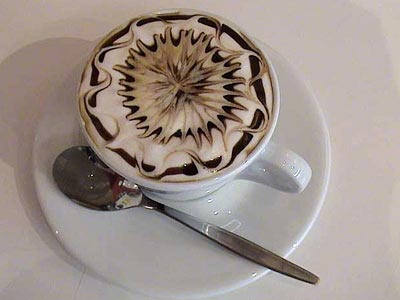
espresso art

coffee9.jpg
Okay. I really think I could totally do this one. Looks pretty obvious to me how it’s done. So please do this tomorrow on your morning cappuccino and send me a photo, ‘mkay? Get on that, crackie.

spanish word of the week

I live in a part of the country where Spanish is the official language. Es la verdad. (It’s true.)

So I’ve been thinking about it, and I really feel that I could offer a public service to you, my readers — based on my vast knowledge of espanol (tilde over the “n” there; I’m using a non-Spanish keyboard here, for shame, don’t tell) — and prepare you for the day when Spanish becomes the official language where you live.

In that spirit of humble service, I offer you:

The Spanish Word of the Week.

Basically, I’ll present you a word, tell you its part (or parts) of speech, and use it in a sentence for you. Okay?

This week’s word is …. Dos.

Dos. (adj, pronoun)

Would you like to buy dese or dos?

Dos.

Hope this helps! Stay tuned for next week’s Spanish Word of the Week.

fight for the right

Sarahk talking about “whatevs” in the comments on the last post made me remember this incident: my courageous fight for the right to “whatevs.”

To be totally fair about “whatevs,” I may very well have ganked it from Sheila. I can’t remember. She’ll have to set me straight. If that’s the case, I’m prepared to give credit where credit is due. Please note my deft use of the word “ganked.” Could I be any cooler?

In our collective “whatevs” defense, there’s a guy on a commercial out here on the West Coast who says “whatev.” Granted, he’s a dorky dad figure and he’s saying it wrong, in my opinion, but someone is validating it.

Okay. As a symbol of dorkiness. Fine.

Say it with me now: whatevs.

i have to comment on american idol …

… because it was Andrew Lloyd Webber night. BIG musical theater songs. (Yee-owch.) The show’s long over now, so I’m commenting from memory.

First, I have to say that I think Lord Webber was one of the best, most instructive mentors the show has ever had. I thought he was charming, but, you know, he didn’t coddle them. He was blunt. He talked people out of songs and into better ones. He worked with them on the story of the songs — made them get it, feel it. Thank God for that.

~ Syesha: No surprise she did great with “One Rock & Roll Too Many” from Starlight Express. She’s a theater girl. A Broadway girl. “A working actress” which she will tell you any time you talk to her, apparently. She won’t win this competition, but she might have done that career — the career she could have — a big favor with that one.

~ Jason: He chose “Memories” from Cats. A song I loathe. A show I loathe. Let’s please leave it at that. He got spanked across the board by the judges, but I have to say I found it oddly refreshing to hear that song sung by a man. A man with Jason’s kind of voice, no less. His ethereal warble. Granted, he doesn’t have the breath support for those lower notes — those were all over the place — but he’s unique. He’s himself. No confusing what he did with Betty Buckley’s Grizabella. THANK GOD. I liked it because it wasn’t that.

~ Brooke: Okay. Love her. She’s warm, genuine. She doesn’t have the strongest voice — she’s not a belter; she’s more of a Carole King type — but she is so darn lovable. I really wanted to talk about her because something happened with her last night. She chose “You Must Love Me” from the movie version of Evita. Near the very beginning of the song — about a dozen notes or so into it — she forgot the lyrics, stopped, and asked if she could start again. She did, but she was a bit of a deer in the headlights for the rest of the song. During comments, Poorla, of all people, really came down on her for stopping and starting. “You must never stop and start over,” she said. Simon stood up for her. “I thought it was brave.” I look at it this way: She was barely into the song. This is her moment. She’s competing to win this. She’s only human. I think she was right to stop there, try to get her bearings, and start again. Which would be worse: “La-la-la-ing” through several notes of music until you find the words again or stopping right there and starting over, fresh, sorta? Unfortunately, you could tell how distracted she was by what happened because the rest of the song — I don’t know — it was like she was singing under a blanket or something. But I defend her choice to start over. At that point. I think I’d feel differently if she were farther into the song, though — to be totally wishy-washy about it here. No. Seriously. If she were farther into the song — halfway through the song or something — and that happened; then improvise, make it work, somehow. Years ago, at an audition, I forgot the lyrics to my song about halfway through. This had never happened to me before and it never happened again. Just nerves. Whatever. But on the spot I improvised some lyrics and moved on. They fit the song okay, but anyone familiar with the song watching the audition certainly knew I’d just messed up and covered it. However well or not. My point here is something — what was it? Yes. It’s that I think at some point the performer passes the point of no return as I had in my audition. At that point, you must make it work somehow. But right at the start, virtually, as Brooke was? I give her some wiggle room on that. And maybe American Idol needs to coach contestants about this. I’ve never seen it happen before, but it might be good for the show to set some guidelines. Give some tips. Coach them how to manage the panic that inevitably happens when you find yourself in that spot. There’s the time factor for the show as well. The show is an hour long. (Mostly.) You can’t have someone screw up one minute into a song and decide to start over completely. Just the time factor doesn’t allow it. Anyhoo. Just my thoughts. I really thought Poorla — with her long painful pause and her “You must never stop and start over” was unnecessarily harsh. Didn’t take enough meds, I guess.

~ David: “Think of Me” from Phantom of the Opera. Little David. What can you say about him? He’s annoying. So earnest and well-meaning. A sappy automaton. He cares about every performance being so meaningful. About plucking at my heartstrings. And my heartstrings totally rebel against it. This song is probably the only one I actually like from Phantom and it’s sung by a diva — a diva with gorgeous soprano voice. I hated how he “popped” it up, sounded like a boy-band boy. Ish. Blech. Randy said, “You’re the guy to beat.” And Simon, thank God, said, “Forgettable.” Yep. Although, I do think Little David is the one to beat. Unfortunately. It’s the tweeners, those wieners.

~ Carly: “Jesus Christ Superstar.” There’s something too needy about Carly. She wants it too much. She has an amazing voice, yes, but she can’t ever seem to relax and realize that moment that someone with a voice like hers should have. That transcendent moment. This was probably the best she’s done, but still. She’s just trying too hard. It makes me uncomfortable. And she needs to dress better. And part her hair on the side. And stop scrunching up her face when she sings so that all her features collapse into a column of brackets or parentheses. That’s all I see when she sings. Upside-down punctuation. I’m sure this makes no sense. Whatevs. Turn this sideways and you’ll see what I mean: (((((( Hey, they got after Clay Aiken for his weird facial tics — why not Carly’s bracket-face?

~ Other David: “Music of the Night.” Simon said it best: “You made the best of the song.” Not his style. Not his thang. Still, my prediction? Final two are David and David. Yup. Mark it down, pippa.

Uhm, you can probably tell I mostly wanted to talk about the Brooke thing. Why didn’t I just do that? Well, because you would have missed my searing bracket-face insight.

All right. There you have it.

the name meme

Thinking is for suckers, yo. Plus, it’s Friday. Almost. And I is taahhrd. So I made up a little meme thingy.

Finish the name however you want — with whoever comes into your mind first. Person can be from life or fiction, but not made up by vous, ustedes, or y’all. (Why? Because I’m a despot.) Copy and paste into the comment section. Don’t read anyone else’s answers until you’re done. Let’s see if great minds think alike. And also if they don’t cheat. 😉

1. Henry

2. Robert

3. Elizabeth

4. Tommy

5. John

6. Katie

7. Norma

8. Joan

9. Christopher

10. William

11. Rebecca

12. Edith

13. Patrick

14. Mount

15. Lake

16. Marie

17. Leonard

18. Dr.

19. Princess

20. Saint