
To the dark dark middle of nowhere ….
Brother-in-law and his wife get the Clawing Tortoise Room.
WE get the, um, motor home in the driveway.
Let’s not speak about it now.
To the dark dark middle of nowhere ….
Brother-in-law and his wife get the Clawing Tortoise Room.
WE get the, um, motor home in the driveway.
Let’s not speak about it now.
Oh, the month is getting away from me!
You know, I watched “It’s a Wonderful Life” the other night and I am always ripped apart by this scene between young George and Mr. Gower, only about 10 minutes into the movie. Mr. Gower has just received a telegram notifying him of his son’s death. George has seen the telegram, too, and that Mr. Gower has been drinking heavily. Gower gives George the task to deliver some medicine, but he’s so drunk and despairing, he doesn’t realize he put poison in the capsules instead of medicine. George knows, though, and runs to dad for advice on what to do. Dad, of course, is in the middle of a brouhaha with Mr. Potter and can’t help George, so George is left to decide for himself what to do with the poisoned pills. He doesn’t deliver them, but heads back to the drugstore — and Mr. Gower.
Every year when I watch this scene, I end up sobbing. The scene, to me, is raw and real and powerful and I love how neither actor — Robert Anderson as young George and H. B. Warner as Mr. Gower — holds back anything. I mean, that kid playing George looks about 12 or 13 to me. Such an awkward age. I’ve taught drama to that age group and most boys that age, even boys with interest in performing, just stumble about, self-conscious, unable to control their changing voices, their clumsy bodies, and uncomfortable with any raw emotion — other than rage. Rage they could do okay, in a “Look! I am SO raging!” kind of way.
But this beautiful kid — literally, physically beautiful kid — Robert Anderson — who I know from nothing else other than this movie — is completely unafraid to go there. He has to be terrified. He has to be beaten. He has to cry. He has to cower. He has to beg. And he has to come out on top, really. Win the moment because it’s life or death. All in this one short scene. And he does it. And you never for a moment think he’s a wuss — which is what my male students’ objection to playing a scene like this would have been. He’s a young man in this scene and he’s totally willing to be ripped apart for a cause bigger than himself. I just always find myself amazed by him in this scene — and the scenes previous, where he’s deflecting Violet’s flirtation — “Help me down, Georgie?” “HELP YA DOWN??” Hahahahaha. Like, he’s so not going there with her silliness. Are ya nuts, Violet? He seems to know what he is and what he’s not. At least at this point in the film. Even now, he won’t sell out his core or suffer fools and this young actor GETS that. In a totally unself-conscious way. He’s a hero of the best kind — a hero who doesn’t know he’s being a hero. Oh, and the moment when Gower realizes what he’s done and literally crushes George to him and George is still crying out about his ear, all afraid? Heartstopping. I love that. He’s still a terrified kid, trying to protect himself, and yet completely sacrificing himself, too. And that Mr. Gower has really smacked him around; there’s blood coming from George’s ear. It’s horrifying, the violence, the helplessness of George in that moment. All he has is his words, his pleas. Can he get through to Gower with just his words?
The scene is physically painful to watch, actually. Like you’re watching an actual beating of an actual kid by an actual hideous drunk. But that’s its brilliance; its greatness. No one holds back. Every year I think about what it must have been like to be Robert Anderson, a kid of that weird, awkward age thumbing through his script and finding THAT scene. A scene requiring that of him. A scene that says — without ever really saying it — “You have to basically be naked here. You must be okay with that. You must do it.” Wow. And he does it. I love that kid.
The scene is one of my favorites in the entire movie. Here’s the excerpt from the screenplay.
BACK TO DRUGSTORE
INT. BACK ROOM – GOWER’S DRUGSTORE – DAY
CLOSE SHOT
Gower talking on the telephone. George stands in the doorway.
GOWER (drunkenly)
Why, that medicine should have been there an hour ago. It’ll be over in five minutes, Mrs. Blaine.
He hangs up the phone and turns to George.
GOWER
Where’s Mrs. Blaine’s box of capsules?
He grabs George by the shirt and drags him into the back room.
GEORGE
Capsules …
GOWER (shaking him)
Did you hear what I said?
GEORGE (frightened)
Yes, sir, I…
Gower starts hitting George about the head with his open hands. George tries to protect himself as best he can.
GOWER
What kind of tricks are you playing, anyway? Why didn’t you deliver them right away? Don’t you know that boy’s very sick?
GEORGE (in tears)
You’re hurting my sore ear.
INT. FRONT ROOM DRUGSTORE – DAY
CLOSE SHOT
Mary is still seated at the soda fountain. Each time she hears George being slapped, she winces.
INT. BACK ROOM DRUGSTORE – DAY
CLOSE SHOT – GEORGE AND GOWER
GOWER
You lazy loafer!
GEORGE (sobbing)
Mr. Gower, you don’t know what you’re doing. You put something
wrong in those capsules. I know you’re unhappy. You got that
telegram, and you’re upset. You put something bad in those capsules. It
wasn’t your fault, Mr. Gower . . .
George pulls the little box out of his pocket. Gower savagely
rips it away from him, breathing heavily, staring at the boy
venomously.
GEORGE
Just look and see what you did. Look at the bottle you took the
powder from. It’s poison! I tell you, it’s poison! I know you
feel bad . . . and .. .
George falters off, cupping his aching ear with a hand. Gower looks at the large brown bottle which has not been replaced on the shelf. He tears open the package, shakes the powder out of one of the capsules, cautiously tastes it, then abruptly throws the whole mess to the table and turns to look at George again. The boy is whimpering, hurt, frightened. Gower steps toward him.
GEORGE
Don’t hurt my sore ear again.
But this time Gower sweeps the boy to him in a hug and, sobbing
hoarsely, crushes the boy in his embrace. George is crying too.
GOWER
No . . . No . . . No. . .
GEORGE
Don’t hurt my ear again!
GOWER (sobbing)
Oh, George, George . . .
GEORGE
Mr. Gower, I won’t ever tell anyone. I know what you’re feeling.
I won’t ever tell a soul. Hope to die, I won’t.
GOWER
Oh, George.
Last excerpt from Philip Yancey’s The Jesus I Never Knew, as we approach Christmas. I hope those of you who have read through these have felt that you’ve gotten something out of them, something new to think about through the holiday.
Anyway, last part here. I love this part; my heart feels bigger somehow when I read it.
There is one more view of Christmas I have never seen on a Christmas card, probably because no artist, not even William Blake, could do it justice. Revelation 12 pulls back the curtain to give us a glimpse of Christmas as it must have looked from somewhere far beyond Andromeda: Christmas from the angels’ viewpoint.
The account differs radically from the births stories in the Gospels. Revelation does not mention shepherds and an infanticidal king; rather, it pictures a dragon leading a ferocious struggle in heaven. A woman clothed with the sun and wearing a crown of twelve stars cries out in pain as she is about to give birth. Suddenly the enormous red dragon enters the picture, his tail sweeping a third of the stars out of the sky and flinging them to the earth. He crouches hungrily before the woman, anxious to devour her child the moment it is born. At the last second the infant is snatched away to safety, the woman flees into the desert, and all-out cosmic war begins.
Revelation is a strange book by any measure, and readers must understand its style to make sense of this extraordinary spectacle. In daily life two parallel histories occur simultaneously, one on earth and one in heaven. Revelation, however, views them together, allowing a quick look behind the scenes. On earth a baby was born, a king got wind of it, a chase ensued. In heaven the Great Invasion had begun, a daring raid by the ruler of the forces of good into the universe’s seat of evil.
John Milton expressed this point of view majestically in Paradise Lost and Paradise Regained, poems which make heaven and hell the central focus and earth a mere battleground for their clashes. The modern author J. B. Phillips also attempted such a point of view, on a much less epic scale, and last Christmas I turned to Phillips’s fantasy to try to escape my earthbound viewpoint.
In Phillips’s version, a senior angel is showing a very young angel around the splendors of the universe. They view whirling galaxies and blazing suns, and then flit across the infinite distances of space until at last they enter one particular galaxy of 500 billion stars.
As the two of them drew near to the star which we call our sun and to its circling planets, the senior angel pointed to a small and rather insignificant sphere turning very slowly on its axis. It looked as dull as a dirty tennis ball to the little angel, whose mind was filled with the size and glory of what he had seen.
“I want you to watch that one particularly,” said the senior angel, pointing with his finger.
“Well, it looks very small and rather dirty to me,” said the little angel. “What’s special about that one?”
When I read Phillips’s fantasy, I thought of the pictures beamed back to earth from the Apollo astronauts, who described our planet as “whole and round and beautiful and small,” a blue-and-green-and-tan globe suspended in space. Jim Lovell, reflecting on the scene later, said, “It was just another body, really, about four times bigger than the moon. But it held all the hope and all the life and all the things that the crew of Apollo 8 knew and loved. It was the most beautiful thing there was to see in all the heavens.” That was the viewpoint of a human being.To the little angel, though, earth did not seem so impressive. He listened in stunned disbelief as the senior angel told him that this planet, small and insignificant and not overly clean, was the renowned Visited Planet.
“Do you mean that our great and glorious Prince … went down in Person to this fifth-rate little ball? Why should He do a thing like that?”
The little angel’s face wrinkled in disgust. “Do you mean to tell me,” he said, “that He stooped so low as to become one of those creeping, crawling creatures of that floating ball?”
“I do, and I don’t think He would like you to call them ‘creeping, crawling creatures’ in that tone of voice. For, strange as it may seem to us, He loves them. He went down to visit them to lift them up to become like Him.”
The little angel looked blank. Such a thought was almost beyond his comprehension.
It is almost beyond my comprehension too, and yet I accept that this notion is the key to understanding Christmas and is, in fact, the touchstone of my faith. As a Christian, I believe I live in parallel worlds. One world consists of hills and lakes and barns and politicians and shepherds watching their flocks by night. The other consists of angels and sinister forces and somewhere out there places called heaven and hell. One night in the cold, in the dark, among the wrinkled hills of Bethlehem, those two worlds came together at a dramatic point of intersection. God, who knows no before or after, entered time and space. God, who knows no boundaries took on the shocking confines of a baby’s skin, the ominous restraints of mortality.“He is the image of the invisible God, the firstborn over all creation,” an apostle would later write; “He is before all things, and in him all things hold together.” But the few eyewitnesses on Christmas night saw none of that. They saw an infant struggling to work never-before-used lungs.
Could it be true, this Bethlehem story of a Creator descending to be born on one small planet? If so, it is a story like no other. Never again need we wonder whether what happens on this dirty little tennis ball of a planet matters to the rest of the universe. Little wonder a choir of angels broke out in spontaneous song, disturbing not only a few shepherds but the entire universe.
Continuing from Philip Yancey’s The Jesus I Never Knew.
I think I’ll have only one more after this one.
Again, I’m starting with a couple of sentences from the last excerpt to help give this one more of a context:
After reading the birth stories once more, I ask myself, If Jesus came to reveal God to us, then what do I learn about God from that first Christmas?
The word associations that come to mind as I ponder that question take me by surprise. Humble, approachable, underdog, courageous — these hardly seem appropriate words to apply to deity.
Courageous. In 1993 I read a news report about a “Messiah sighting” in the Crown Heights section of Brooklyn, New York. Twenty thousand Lubavitcher Hasidic Jews live in Crown Heights, and in 1993 many of them believed the Messiah was dwelling among them in the person of Rabbi Menachem Mendel Schneerson.
Word of the Rabbi’s public appearance spread like a flash fire through the streets of Crown Heights, and Lubavitchers in their black coats and curly sideburns were soon dashing down the sidewalks toward the synagogue where the Rabbi customarily prayed. Those lucky enough to be connected to a network of beepers got a head start, sprinting toward the synagogue the instant they felt a slight vibration. They jammed by the hundreds into a main hall, elbowing each other and even climbing the pillars to create more room. The hall filled with an air of anticipation and frenzy normally found at a championship sporting event, not a religious service.
The Rabbi was ninety-one years old. He had suffered a stroke the year before and had not been able to speak since. When the curtain finally pulled back, those who had crowded into the synagogue saw a frail old man in a long beard who could do little but wave, tilt his head, and move his eyebrows. No one in the audience seemed to mind, though. “Long live our master, our teacher, and our rabbi, King, Messiah, forever and ever!” they sang in unison, over and over, building in volume until the Rabbi made a small delphic gesture with his hand and the curtain closed. They departed slowly, savoring the moment, in a state of ecstasy.
When I first read the news account, I nearly laughed out loud. Who are these people trying to kid — a nonagenarian mute Messiah in Brooklyn? And then it struck me: I was reacting to Rabbi Schneerson exactly as people in the first century had reacted to Jesus. A Messiah from Galilee? A carpenter’s kid, no less?
The scorn I felt as I read about the Rabbi and his fanatical followers gave me a clue to the responses Jesus faced throughout his life. His neighbors asked, “Isn’t his mother’s name Mary and aren’t his brothers James, Joseph, Simon, and Judas? Where did this man get this wisdom and these miraculous powers?” Other countrymen scoffed, “Nazareth! Can anything good come from there?” His own family tried to put him away, believing he was out of his mind. The religious experts sought to kill him. As for the whipsaw commoners, one moment they judged him “demon-possessed and raving mad,” the next they forcibly tried to crown him king,
It took courage, I believe, for God to lay aside power and glory and to take a place among human beings who would greet him with the same mixture of haughtiness and skepticism that I felt when I first heard about Rabbi Schneerson of Brooklyn. It took courage to risk descent to a planet known for its clumsy violence, among a race known for rejecting its prophets. What more foolhardy thing could God have done?
The first night in Bethlehem required courage as well. How did God the Father feel that night, helpless as any human father, watching his Son emerge smeared with blood to face a harsh, cold world? Lines from two different Christmas carols play in my mind. One, “The little Lord Jesus, no crying he makes,” seems to me a sanitized version of what took place in Bethlehem. I imagine Jesus cried like any other baby the night he entered the world, a world that would give him much reason to cry as an adult. The second, a line from “O Little Town of Bethlehem,” seems as profoundly true today as it did two thousand years ago: “The hopes and fears of all the years are met in thee tonight.”
“Alone of all creeds, Christianity has added courage to the virtues of the Creator,” said G. K. Chesterton. The need for such courage began with Jesus’ first night on earth and did not end until his last.
(one) more to come …
Sooo …. what did everybody do today? Some shopping? Some baking? Some tree trimming? Good for you.
Uhm, did anyone succumb to peer pressure and make a Christmas ornament in 10 minutes using only materials found at their place of work?
Anyone else besides me, that is?
People … I have gone around the bend. I am so far PAST the bend that the bend is a straight line to me now.
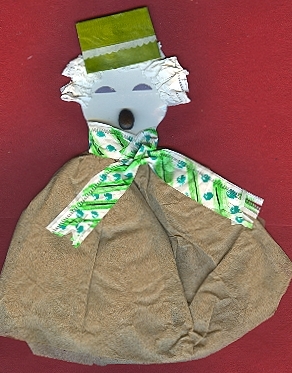
I have to take my ornament back to work, but — and this is just how big of a dork I am — I kidnapped it so I could scan it. So I present to you now my — I don’t know — Victorian Christmas caroler?? It’s not nearly as good as the Perrier bottle Christmas tree with bus-token-“tip” ornaments, but, ah, well. One does what one can.
Her head: a sample cup bottom
Her hair: scrunched-up straw wrapper
Her eyes: crescents cut from a Dixie cup
Her mouth: a singing coffee bean, of course
Her cape: a napkin
Her scarf: a colored straw wrapper
Her hat: cut from a pastry bag
You know, maybe I’ll get some good rest over Christmas. The dark dark middle of nowhere is looking better all the time
A lady rushed into The Beanhouse yesterday, all flustered and furrowed.
“This is one of those things that’s gonna seem funny in about an hour, but right now … oh, I’m so embarrassed.” She held up her hand. Her two middle fingers were STUCK inside one of these:

It came off just seconds later but, uhm, what I want to know is: What is the thought process here?
“My fingers are wedged in a spool of curling ribbon! To the coffeehouse — IMMEDIATELY!!” ???
On one of our first married visits to my in-laws’ home in a little mountain town called “Privacy-What’s Dat?” my mother-in-law set us up in the guest /sewing/random piles of junk room. She asked us to keep the door open. (Excuse me? Yeah. We didn’t do that. MB laughed and closed the door.) The bed was frou-frouey and small — a double, I think. At home we have a king-sized bed because MB is so tall.
So, our first night there, I’m lying on my six inches of frouf, dozing fitfully because I’m afraid of falling out of the bed. I need to pee, but I’m also afraid of getting up because the bathroom door is just a sliding door and right across from the in-laws’ bedroom and what if they hear it sliding and know I’m peeing? Or worse, what if they hear me peeing? I need a door that closes, all solid and quiet. I have issues, people.
I just lie there, teetering on the mattress, talking myself out of peeing.
Suddenly, there are random scratching noises in the room. Kinda loud. Now, we are in the mountains where night is dark, very dark. Like “I’m sorta afraid how dark it is here” dark. So, great. I’m lying in a room full of childhood dark complete with creepy scratching noises. I’m now wide awake. Like anyone would, I just assume it’s that urban legend dude with the hook hand come to kill me in the deep dark middle of nowhere. My heart is racing. MB is snoring softly beside me dreamily unaware of our imminent, pointy demise.
The scratching continues, even louder now. Hook man is serious about this. That’s it. MB has to save me.
Shove — shove — shove.
Groggy. “Whaaa?”
“Do you hear that scratching? Do you HEAR it?”
Scratching.
“Yeah.” He turns his head towards me, groaning.
“It’s totally freaking me out. What IS it?”
“Honey …. it’s just the tortoise in the drawer ….” He yawns and rolls away from me. Nothing could possibly be more boring to him.
“WHAT????”
“The tortoise in the drawer …” he slurs again, a twinge of irritation.
“What are you talking about??”
“It’s the tortoise. He’s hibernating. In the drawer of that dresser.”
Silence as I take in that there is a slow leathery creature trapped in a dresser drawer a few feet away from where I’m trying to sleep and trying not to pee. I am deeply freaked out in a way that hook man could not even begin to touch.
“He’s hibernating??”
“Yes.”
“But …. obviously, he’s not! He’s trapped in there, clawing away for his very life!” For emphasis, I claw the air frantically, much like a tortoise would. In the deep dark nowhere, I am instantly an expert on the needs of tortoises in general.
“Honey …. he’s probably moving around in his sleep …. just leave him alone. Go back to sleep …” He abandons me to my slice of the mattress, falls back asleep instantly.
Finally, much later, I drift restlessly off in the deep dark middle of nowhere to the soothing sounds of a claustrophobic hibernating tortoise clawing away for his very life.
I never did get to pee that night.
Continuing from Philip Yancey’s The Jesus I Never Knew. Again, I’m starting with a couple of sentences from the last excerpt to help give this one more of a context:
After reading the birth stories once more, I ask myself, If Jesus came to reveal God to us, then what do I learn about God from that first Christmas?
The word associations that come to mind as I ponder that question take me by surprise. Humble, approachable, underdog, courageous — these hardly seem appropriate words to apply to deity.
Underdog. I wince even as I write the word, especially in connection with Jesus. It’s a crude word, probably derived from dogfighting and applied over time to predictable losers and victims of injustice. Yet as I read the birth stories about Jesus, I cannot help but conclude that though the world may be tilted toward the rich and the powerful, God is tilted toward the underdog. “He has brought down rulers from their thrones but has lifted up the humble. He has filled the hungry with good things but has sent the rich away empty,” said Mary in her Magnificat hymn.
Lazlo Tokes, the Romanian pastor whose mistreatment outraged the country and prompted rebellion against the Communist ruler Ceausescu, tells of trying to prepare a Christmas sermon for the tiny mountain church to which he had been exiled. The state police were rounding up dissidents, and violence was breaking out across the country. Afraid for his life, Tokes bolted the doors, sat down, and read again the stories in Luke and Matthew. Unlike most pastors who would preach that Christmas, he chose as his text the verses describing Herod’s massacre of the innocents. It was the single passage that spoke most directly to his parishioners. Oppression, fear, and violence, the daily plight of the underdog, they well understood.
The next day, Christmas, new broke that Ceausescu had been arrested. Church bells rang, and joy broke out all over Romania. Another King Herod had fallen. Tokes recalls, “All the events of the Christmas story now had a new, brilliant dimension for us, a dimension of history rooted in the reality of our lives …. For those of us who lived through them, the days of Christmas 1989 represented a rich, resonant embroidery of the Christmas story, a time when the providence of God and the foolishness of human wickedness seemed as easy to comprehend as the sun and moon over the timeless Transylvanian hills.” For the first time in four decades, Romania celebrated Christmas as a public holiday.
Perhaps the best way to perceive the “underdog” nature of the incarnation is to transpose it into terms we can relate to today. An unwed mother, homeless, was forced to look for shelter while traveling to meet the heavy taxation demands of a colonial government. She lived in a land recovering from violent civil wars and still in turmoil — a situation much like that in modern Bosnia, Rwanda, or Somalia. Like half of all mothers who deliver today, she gave birth in Asia, in its far western corner, the part of the world that would prove least receptive to the son she bore. That son became a refugee in Africa, the continent where most refugees can still be found.
I wonder what Mary thought about her militant Magnificat hymn during her harrowing years in Egypt. For a Jew, Egypt evoked bright memories of a powerful God who had flattened a pharaoh’s army and brought liberation; now Mary fled there, desperate, a stranger in a strange land hiding from her own government. Could her baby, hunted, helpless, on the run, possibly fulfill the lavish hopes of his people?
Even the family’s mother-tongue summoned up memories of their underdog status: Jesus spoke Aramaic, a trade language closely related to Arabic, a stinging reminder of the Jews’ subjection to foreign empires.
Some foreign astrologers (probably from the region that is now Iraq) had dropped by to visit Jesus, but these men were considered “unclean” by Jews of the day. Naturally, like all dignitaries they had checked first with the ruling king in Jerusalem, who knew nothing about a baby in Bethlehem. After they saw the child and realized who he was, these visitors engaged in an act of civil disobedience: they deceived Herod and went home another way, to protect the child. They had chosen Jesus’ side, against the powerful.
Growing up, Jesus’ sensibilities were affected most deeply by the poor, the powerless, the oppressed — in short, the underdogs. Today, theologians debate the aptness of the phrase “God’s preferential option for the poor” as a way of describing God’s concern for the underdog. Since God arranged the circumstances in which to be born on planet earth — without power or wealth, without rights, without justice — his preferential options speak for themselves.
more to come …
Spontaneous song description of homeless fellow in the Santa hat panhandling at the intersection across from our car:
Santa beggar
You’re smellin’ pretty rummy; it’s true
You do
Had too many glasses of brew
Please, don’t come down my chimney tonight
Santa beggar
I see those gin blossoms from here
(spoken) Oh, dear
And that big wet stain on your rear
Just don’t come down my chimney tonight
Later that same day, as MB and I were rearranging some stuff around the house, we debated from different rooms about where something should go. We were getting nowhere. Finally … I was overcome by a seasonal ditty once AGAIN and managed to end the discussion with:
“Uhm, honey? ‘Let it go, let it go, let it GO-O-OOHHHH!!!'”
Okay. Something’s really wrong with me ….
Continuing from Philip Yancey’s The Jesus I Never Knew. I love this particular section, love his illustrations here. I’m starting with a couple sentences from the last excerpt to help give this one more of a context:
After reading the birth stories once more, I ask myself, If Jesus came to reveal God to us, then what do I learn about God from that first Christmas?
The word associations that come to mind as I ponder that question take me by surprise. Humble, approachable, underdog, courageous — these hardly seem appropriate words to apply to deity.
Approachable. Those of us raised in a tradition of informal or private prayer may not appreciate the change Jesus wrought in how human beings approach deity. Hindus offer sacrifices at the temple. Kneeling Muslims bow down so low that their foreheads touch the ground. In most religious traditions, in fact, fear is the primary emotion when one approaches God. Certainly the Jews associated fear with worship. The burning bush of Moses, the hot coals of Isaiah, the extraterrestrial visions of Ezekiel — a person “blessed” with a direct encounter with God expected to come away scorched or glowing or maybe half-crippled like Jacob. These were the fortunate ones: Jewish children also learned stories of the sacred mountain in the desert that proved fatal to everyone who touched it. Mishandle the ark of the covenant, and you died. Enter the Most Holy Place, and you’d never come out alive.
Among people who walled off a separate sanctum for God in the temple and shrank from pronouncing or spelling out the name, God made a surprise appearance as a baby in a manger. What can be less scary than a newborn with his limbs wrapped tight against his body? In Jesus, God found a way of relating to human beings that did not involve fear.
In truth, fear had never worked very well. The Old Testament includes far more low points than high ones. A new approach was needed, a New Covenant, to use the words of the Bible, one that would not emphasize the vast gulf between God and humanity but instead would span it.
A friend of mine named Kathy was using a “Can you guess?” game to help her six-year-old learn the different animals. His turn: “I’m thinking of a mammal. He’s big and he does magic.” Kathy thought for a while and then gave up. “I don’t know.” “It’s Jesus!” said her son in triumph. The answer seemed irreverent at the time, Kathy told me, but later as she thought about it, she realized her son had hit upon an unsettling insight into the depths of incarnation: Jesus as a mammal!
I learned about incarnation when I kept a salt-water aquarium. Management of a marine aquarium, I discovered, is no easy task. I had to run a portable chemical laboratory to monitor the nitrate levels and the ammonia content. I pumped in vitamins and antibiotics and sulfa drugs and enough enzymes to make a rock grow. I filtered the water through glass fibers and charcoal, and exposed it to ultraviolet light. You would think, in view of all the energy expended on their behalf, that my fish would at least be grateful. Not so. Every time my shadow loomed above the tank they dove for cover into the nearest shell. They showed me one “emotion” only: fear. Although I opened the lid and dropped food on a regular schedule, three times a day, they responded to each visit as a sure sign of my designs to torture them. I could not convince them of my true concern. To my fish I was deity. I was too large for them, my actions too incomprehensible. My acts of mercy they saw as cruelty; my attempts at healing they viewed as destruction. To change their perceptions, I began to see, would require a form of incarnation. I would have to become a fish and “speak” to them in a language they could understand.
A human being becoming a fish is nothing compared to God becoming a baby. And yet according to the Gospels that is what happened at Bethlehem. The God who created matter took shape within it, as an artist might become a spot on a painting or a playwright a character within his own play. God wrote a story, only using real characters, on the pages of real history. The Word became flesh.
more to come ….